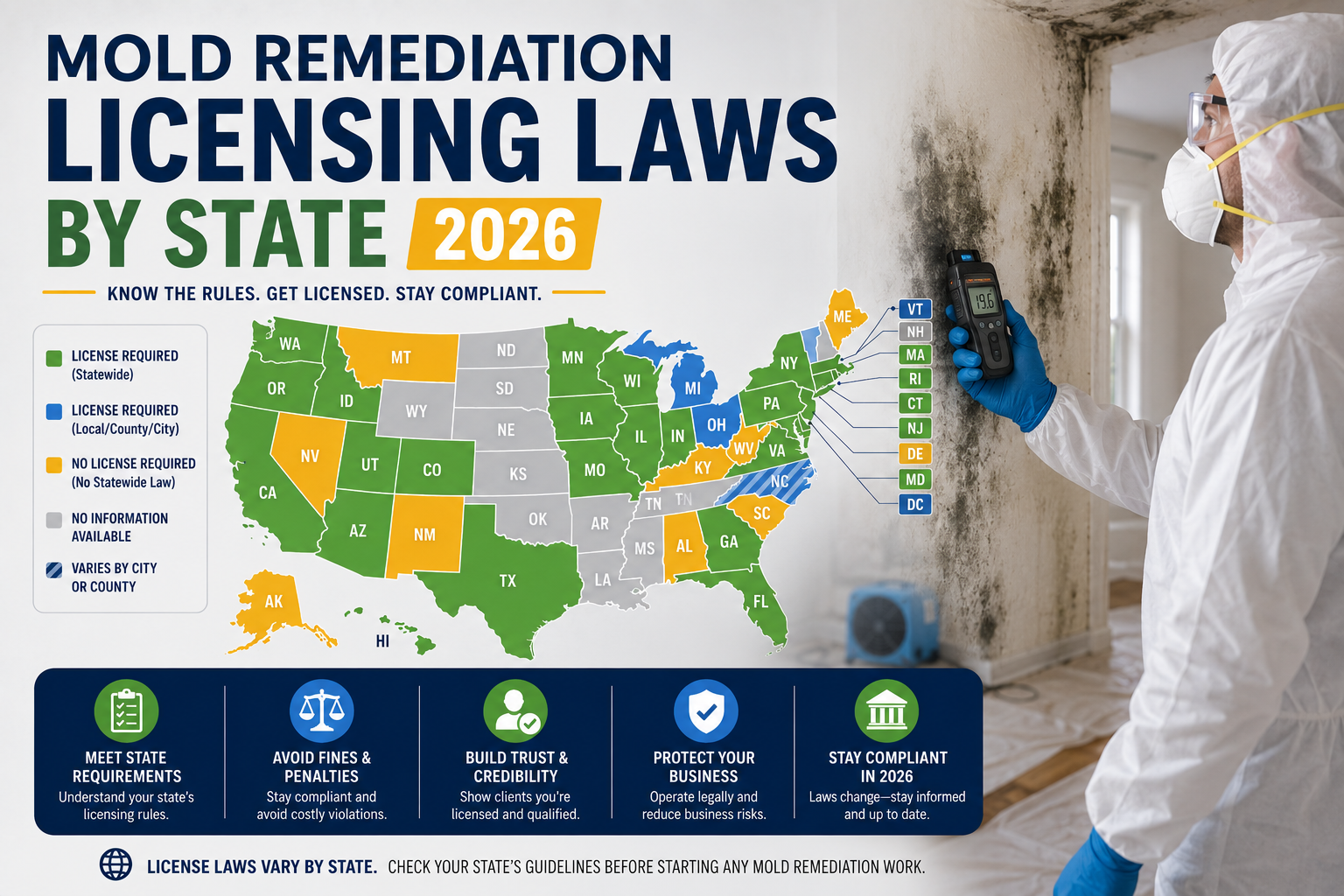
Mold remediation licensing laws by state differ enough that a restoration company operating in more than one state genuinely cannot assume the same rules, thresholds, or credentials apply everywhere. Some states require a single license. Others legally require two separate companies for the same job. Some states have no dedicated mold license at all. Getting this wrong in marketing or in actual practice creates real legal and trust problems.
The Three Things That Actually Vary State to State
1. Whether a state licenses mold work at all. Only a handful of states require a dedicated mold assessment or remediation license. Many, including California, Georgia, and Ohio, have no state-specific mold license, which means IICRC certification (S500 for water damage, S520 for mold) becomes the primary credential homeowners can actually verify.
2. The square-footage threshold that triggers licensing requirements. In states that do require licensing, the threshold for when it kicks in isn’t consistent. Texas requires a TDLR-licensed Mold Assessor or Remediator for jobs over 25 contiguous square feet. Florida and New York both set the bar lower, at 10 square feet — meaning substantially more jobs legally require a licensed professional in those states than in Texas.
3. Whether the same company can both assess and remediate. This is the detail most out-of-state restoration companies get wrong. Florida’s Mold-Related Services Act prohibits a licensed assessor from remediating any property they assessed within the previous 12 months. New York’s Article 32, enforced by the state’s Department of Labor rather than a licensing board, has a nearly identical restriction. Texas has no equivalent rule — the same TDLR-licensed company can legally assess and remediate the same job.
Why the Assessor/Remediator Split Matters So Much
For a restoration company used to operating in a state like Texas, where one company handles the full job, expanding into Florida or New York without accounting for the assessor/remediator split creates a real compliance problem, not just a marketing inconsistency. Companies in those states typically need to structure around referral relationships — either partnering with a separate licensed assessor, or explicitly marketing as “assessment only” or “remediation only,” rather than a single “we do it all” offering.
This split exists for a specific reason in both states. New York’s Article 32 was enacted in 2016 as a direct response to improper mold abatement uncovered after Superstorm Sandy — a conflict-of-interest concern, since a company financially incentivized to find mold during an assessment has an obvious reason to inflate the scope of remediation work it then sells itself.
What This Means for Marketing and Operations
1. Don’t assume your home-state licensing model transfers. A restoration company built around Texas’s single-license, no-split model needs a genuinely different operational and marketing structure to expand into Florida or New York — not just updated ad copy.
2. In states with a low square-footage threshold, more jobs require licensing than you might expect. A 10-square-foot threshold, as in Florida and New York, catches far more residential jobs than a 25-square-foot threshold does. Campaigns and intake processes in those states should assume licensing applies more often, not less.
3. In states with no dedicated mold license, lead with IICRC certification. Where there’s no state-specific credential to reference, IICRC certification is the verifiable standard homeowners can actually check, and it should be featured prominently in ad copy and on service pages.
4. If operating in a split-requirement state, be explicit about which role you’re marketing. A landing page that doesn’t clarify whether you’re offering assessment, remediation, or both — in a state that legally requires them to be separate — creates confusion at exactly the point a homeowner is deciding whether to call.
FAQ
Do all states require a mold remediation license?
No. States including California, Georgia, and Ohio have no dedicated state mold license, relying instead on IICRC certification as the primary verifiable credential.
Why do Florida and New York require separate companies for assessment and remediation?
Both laws exist to prevent a conflict of interest — a company financially incentivized to find mold during an assessment has an obvious reason to inflate the remediation work it then sells. New York’s law was enacted specifically in response to abuses uncovered after Superstorm Sandy.
What size job requires a mold license in states that have one?
It varies. Texas sets the threshold at 25 contiguous square feet, while Florida and New York both set it lower, at 10 square feet, meaning more jobs require licensed involvement in those two states.
Can a Texas-licensed mold remediation company operate the same way in Florida?
Not without adjustment. Texas allows the same company to assess and remediate a job, while Florida and New York both legally require these to be separate parties — a structural difference that affects operations, not just marketing.
For a closer look at how mold licensing shapes campaign strategy in specific states, see our guides for Texas Water Damage Google Ads, Florida Water Damage Google Ads, and New York Water Damage Google Ads.

Zeeshan Ali is the Founder of EZEGrow, a Google Ads management agency specializing in HVAC, plumbing, and water damage restoration companies across the United States. He focuses on lead generation, call tracking, campaign optimization, and helping home service businesses grow through data-driven Google Ads strategies.