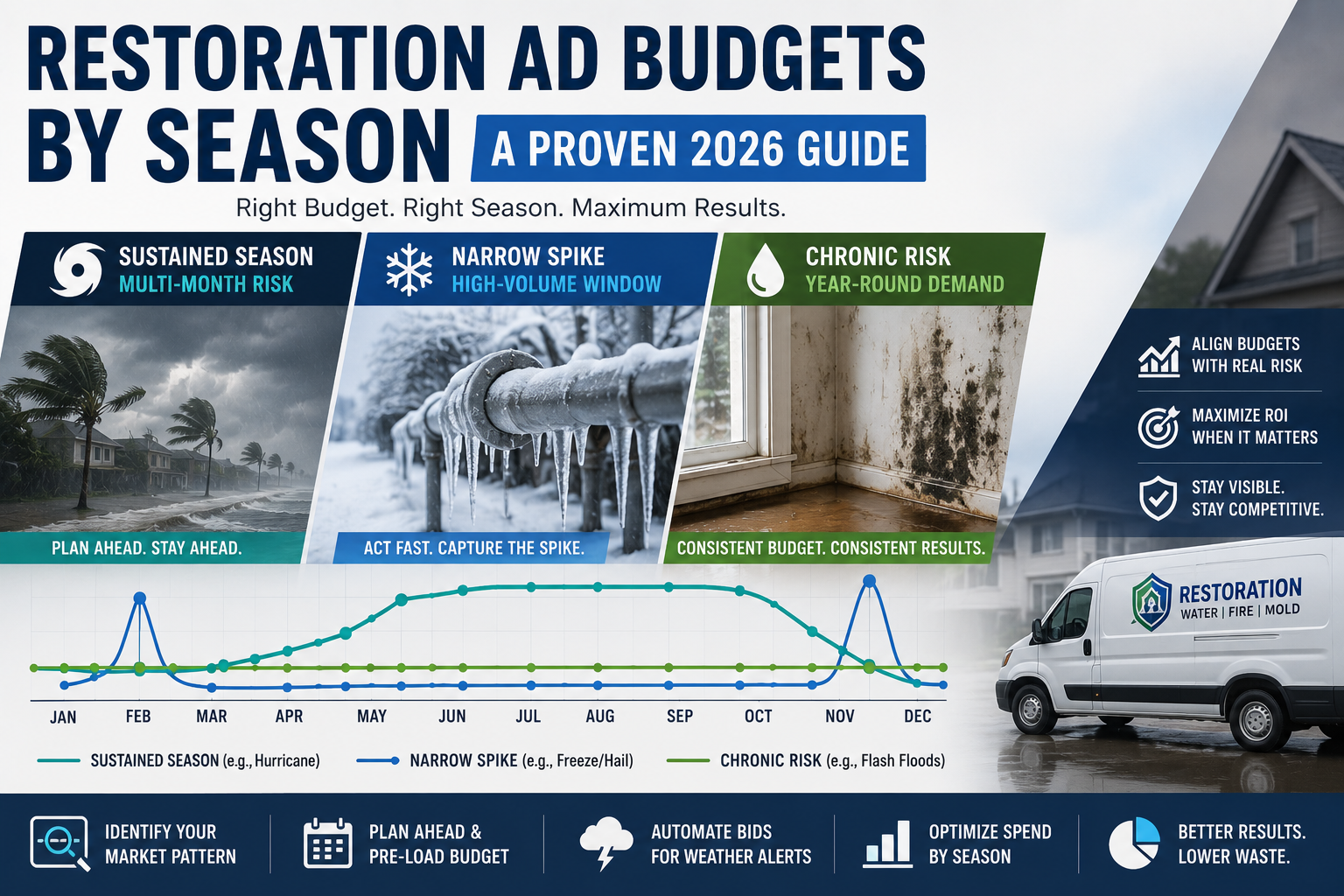
Restoration ad budgets by season need to look completely different depending on what kind of weather risk actually drives demand in a given market — and treating every disaster season the same way is one of the most common budget-wasting mistakes in restoration company marketing. A six-month hurricane season, a narrow freeze-event spike, and a chronic year-round risk all require different bidding strategies, not the same flat monthly budget.
Three Genuinely Different Seasonal Patterns
Sustained, multi-month risk windows. Houston’s hurricane season runs June through November — not a single event, but a sustained six-month window where restoration risk stays meaningfully elevated the entire time. Budget for a market like this should scale up starting in May and stay elevated through the full window, rather than reacting only when a named storm makes headlines.
Narrow, high-volume spike windows. Dallas sits in one of the highest hail-frequency corridors in the country, and also faces hard-freeze burst-pipe events. Both create narrow windows — often just hours — where search volume spikes sharply and then fades once the weather event passes. Static, always-on bidding badly underperforms in this pattern; bids need to scale automatically and immediately when a freeze advisory or major hail event hits.
Chronic, non-seasonal risk. Some restoration demand isn’t seasonal at all. San Antonio’s Flash Flood Alley risk can materialize with very little warning at almost any time of year, driven by Hill Country terrain rather than a predictable calendar pattern. Similarly, Illinois’s combined sewer backup risk in Chicago can spike within the same hour a heavy rain event hits, regardless of season.
Why Treating These the Same Wastes Real Budget
A flat, evenly distributed monthly budget works reasonably well for chronic, non-seasonal risk, since there’s no clear calendar window to concentrate spend around. Applied to a sustained-season market like Houston, that same flat approach underbids the real elevated-risk window from May through November. Applied to a spike-window market like Dallas, it wastes spend during quiet stretches and underbids the narrow hours when a freeze advisory actually drives search volume.
Some markets combine more than one pattern entirely. Georgia’s restoration risk includes both a sudden, historically dramatic flash-flood category — Atlanta’s September 2009 flood remains the reference point homeowners measure new flooding against — and a completely separate, chronic, non-seasonal category tied to the region’s poor-draining red clay soil, which causes foundation water intrusion year-round with no storm involved at all.
Building a Season-Aware Bidding Structure
1. Identify which pattern actually applies to your market — don’t assume. A market can look similar to a neighboring one on a map and still follow a completely different risk pattern. Ohio’s water damage risk, for example, splits between the historic Ohio River corridor’s flood legacy and Lake Erie’s separate shoreline flooding pattern — two different mechanisms requiring two different campaign structures within the same state.
2. For sustained-season markets, pre-load budget ahead of the window. Waiting until hurricane season officially starts to increase spend means missing the early search volume from homeowners doing pre-season preparation research, not just post-storm emergency searches.
3. For spike-window markets, automate bid increases tied to actual weather alerts. Manually checking forecasts and adjusting bids reactively is too slow for windows measured in hours. Campaigns tied to National Weather Service freeze advisories or severe weather alerts capture the highest-intent window automatically instead of after the fact.
4. For chronic-risk markets, maintain steady baseline spend rather than trying to time it. Since there’s no reliable calendar pattern to build a spike-strategy around, a stable, always-on budget performs more consistently than trying to guess timing that doesn’t exist.
5. Where a market has more than one risk pattern, run genuinely separate campaigns. Combining a sustained-season category and a chronic, non-seasonal category into a single campaign — as in Georgia’s flash-flood-versus-red-clay-foundation split — dilutes both, since the keywords, urgency level, and buyer intent differ meaningfully between them.
A Reference Worth Checking Regularly
For markets where hurricane or severe weather timing matters to budget planning, NOAA’s National Weather Service publishes current outlooks and historical seasonal data that’s more reliable than assuming this year’s pattern matches last year’s exactly.
FAQ
Should every restoration company budget seasonally?
Only if their market actually has a seasonal risk pattern. Markets with chronic, non-seasonal risk — like flash-flood-prone terrain — perform better with steady, consistent spend rather than an artificial seasonal curve that doesn’t match real demand.
How far ahead should I increase budget before a known risk season starts?
For sustained-season markets like Gulf Coast hurricane risk, budget should typically start scaling up two to four weeks before the season’s official start, to capture early preparation-focused searches, not just post-event emergency ones.
Can a single market have more than one seasonal pattern?
Yes. Georgia is a clear example, combining a historically significant flash-flood risk category with a completely separate, chronic, year-round foundation-water-intrusion category tied to the region’s soil — and both deserve their own campaign structure.
What’s the risk of not adjusting bids automatically during a spike-window event?
In narrow-window markets, manual bid adjustment is often too slow to matter — by the time a team notices a freeze advisory and manually raises bids, a meaningful share of the highest-intent search window has already passed to competitors with automated rules in place.
For a closer look at how seasonal and regional risk patterns shape specific campaigns, see our guides for Houston Water Damage Google Ads, Dallas Water Damage Google Ads, Ohio Water Damage Google Ads, and Georgia Water Damage Google Ads.

Zeeshan Ali is the Founder of EZEGrow, a Google Ads management agency specializing in HVAC, plumbing, and water damage restoration companies across the United States. He focuses on lead generation, call tracking, campaign optimization, and helping home service businesses grow through data-driven Google Ads strategies.