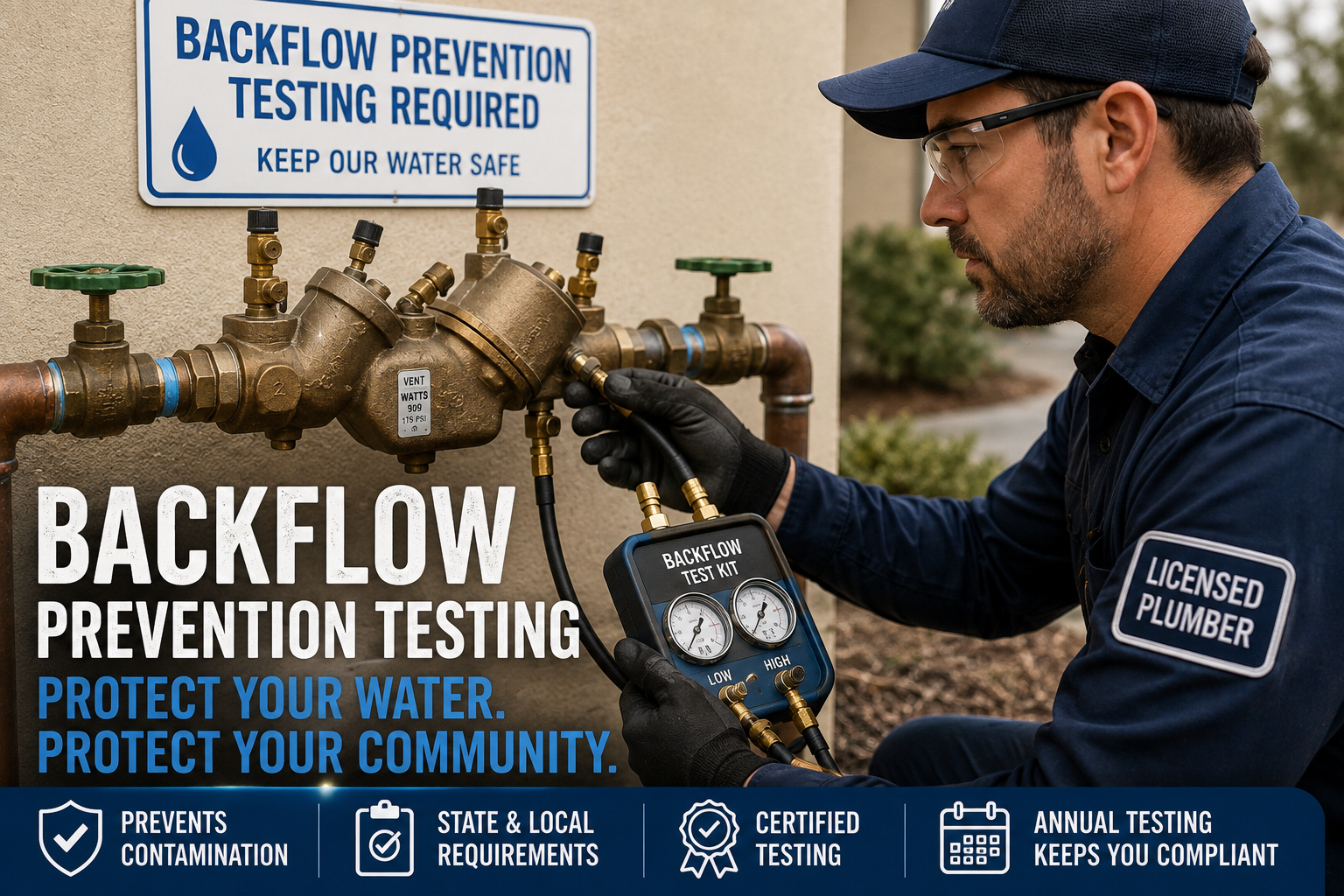
Backflow prevention testing is one of the most overlooked recurring-revenue categories in the plumbing trade — and most plumbing companies don’t market it as its own service at all. It shows up buried under “plumbing services” on a website, if it shows up anywhere, even though it’s a legally mandated, annually recurring job most residential and commercial plumbers are already qualified to do more of.
What Backflow Prevention Testing Actually Is
A backflow preventer is a device installed on a water line to stop contaminated water from flowing backward into the clean public water supply during a pressure drop. Most local water utilities require these devices on commercial connections, irrigation systems, and many residential connections — and most require them to be tested annually by a certified tester, not just installed once and forgotten.
That annual requirement is the part most plumbing businesses miss the marketing value of. It’s not a one-time job. It’s a recurring service with a built-in reason for the customer to call back every single year, on a predictable schedule.
Why This Matters More Than It Looks Like It Should
Compare backflow prevention testing to a typical emergency plumbing call. An emergency call is high-value but unpredictable — you can’t schedule your revenue around it. Backflow testing is the opposite: lower ticket per job (often $120–$350), but genuinely recurring, and the customer isn’t comparison-shopping on price the way they might for a big install, since the requirement itself is the reason they’re calling.
For a plumbing company building a Google Ads strategy, that makes backflow testing a category worth targeting on its own — not folded into a generic “plumbing services” campaign where it gets diluted alongside emergency repair and remodel keywords that behave completely differently.

The Licensing Detail Most Plumbers Underuse in Their Marketing
In many states, a standard plumbing license alone doesn’t authorize backflow testing. Texas is a clear example: the Texas Commission on Environmental Quality (TCEQ) requires a separate Backflow Prevention Assembly Tester (BPAT) license, distinct from a standard TSBPE plumbing license, and issued through a different agency entirely. A plumber who holds both credentials has a real, verifiable trust signal that most competitors in the category don’t advertise clearly, if they mention it at all.
This pattern isn’t unique to Texas. The EPA’s guidance on cross-connection control, which most state and local backflow requirements are built around, treats certified backflow testing as a distinct specialization from general plumbing work nationwide — worth checking against your own state and local utility’s specific certification requirements.
How to Market This as Its Own Category
1. Build a dedicated landing page and campaign, separate from emergency plumbing. Someone searching “backflow prevention testing near me” or “annual backflow test” is not in the same buying mindset as someone with a flooded kitchen. Bidding both the same way either overpays for urgency intent that doesn’t apply here, or underbids a recurring-revenue opportunity.
2. Lead with your specific certification, not just “licensed and insured.” “BPAT certified” or your state’s equivalent backflow-testing credential is a far stronger, more specific trust signal for this exact buyer than a generic license claim.
3. Target commercial property managers directly, not just homeowners. Commercial and irrigation connections are tested more consistently and at higher volume than residential ones in most markets. A campaign that speaks to property managers scheduling mandatory annual compliance work often converts at a meaningfully lower cost per lead than residential-only targeting.
4. Build in a reminder system, and market that you have one. Because the requirement recurs annually, plumbing companies that proactively remind past customers when their next test is due — and mention that reliability in their marketing — build a retention advantage most competitors never bother establishing.
What Realistic Numbers Look Like
Backflow testing campaigns typically run a lower cost-per-click than emergency plumbing keywords, since competition for these specific terms is usually thinner. Combined with the recurring nature of the work, even a modest number of new commercial accounts in a given year compounds into a stable, predictable revenue base most plumbing companies don’t currently have.
FAQ
Do I need a separate license to perform backflow testing?
In many states, yes — a standard plumbing license alone often isn’t sufficient. Check your state’s specific requirement, since the certifying body (as in Texas, where it’s TCEQ rather than the state plumbing board) can be entirely separate from general plumbing licensing.
How often does backflow testing need to be done?
Most jurisdictions require annual testing on qualifying connections, though the specific interval and which connections qualify varies by local water utility, not just by state.
Is backflow testing worth marketing separately from general plumbing services?
Yes, for most companies. Because the buyer behavior, price sensitivity, and search intent differ meaningfully from both emergency repair and installation work, a dedicated campaign consistently outperforms folding it into a general plumbing services page.
Should I target residential or commercial backflow testing first?
Commercial and irrigation-connection testing tends to have higher, more consistent volume and clearer compliance urgency, making it a strong starting point before expanding into residential-focused campaigns.
For a full breakdown of how EZEGrow builds backflow-compliance campaigns around Texas’s specific TCEQ and TSBPE licensing structure, see our Texas Plumbing Google Ads guide.

Zeeshan Ali is the Founder of EZEGrow, a Google Ads management agency specializing in HVAC, plumbing, and water damage restoration companies across the United States. He focuses on lead generation, call tracking, campaign optimization, and helping home service businesses grow through data-driven Google Ads strategies.