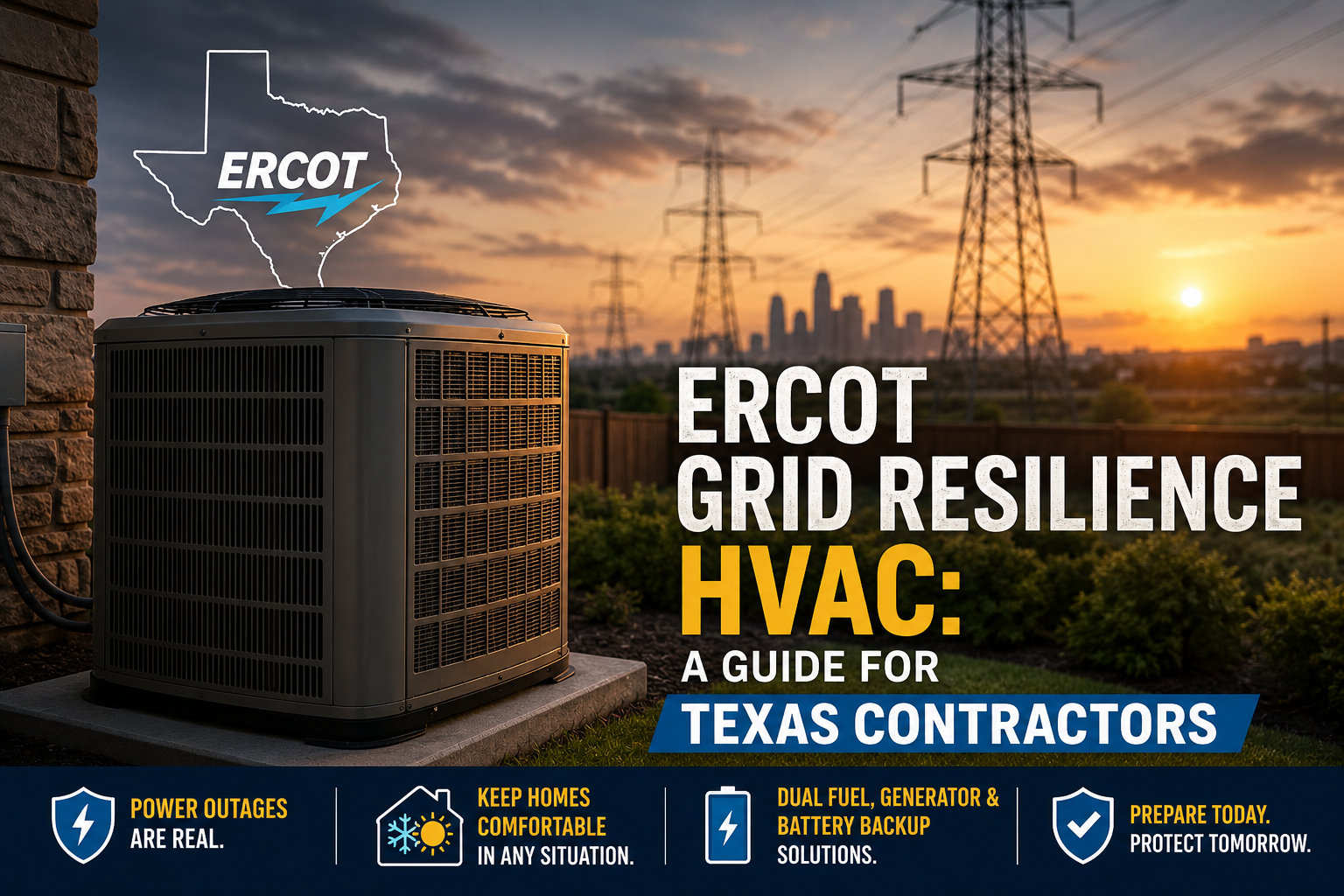
ERCOT grid resilience HVAC demand is one of the fastest-growing, lowest-competition keyword categories most Texas HVAC contractors aren’t targeting yet. If you run an HVAC company in Texas, you’ve probably already noticed homeowners searching for “dual fuel heat pump,” “battery backup HVAC,” and “generator compatible AC system.” This isn’t a passing trend. It’s tied directly to how Texas’s power grid works — and understanding ERCOT grid resilience HVAC demand is quickly becoming essential for any Texas contractor who wants to capture these higher-ticket jobs.
Why ERCOT Grid Resilience HVAC Searches Are Rising in Texas
Texas is the only state in the country with its own independent power grid. ERCOT (the Electric Reliability Council of Texas) operates almost entirely disconnected from the rest of the national grid, connected only by small DC ties. That means during extreme heat or extreme cold, Texas can’t simply import emergency power the way most states can when their own grid is strained.
Winter Storm Uri exposed exactly what that risk looks like. In February 2021, ERCOT’s isolation meant Texas couldn’t pull in outside power fast enough, and millions of homes lost heat for days. Since then, ERCOT has issued conservation appeals during multiple summer heat waves and winter cold snaps, and each time, search interest in backup-capable HVAC systems spikes measurably.
For HVAC contractors, this creates a genuinely new demand category: homeowners who aren’t just replacing a broken system, but specifically researching systems that keep working if the grid can’t.
The Keyword Category Most Campaigns Still Miss
Standard HVAC Google Ads campaigns are built around two buckets: emergency repair (“AC not cooling,” “no heat emergency”) and routine replacement (“new AC installation,” “furnace replacement cost”). Grid-resilience searches don’t fit either bucket, and most agencies bid them the same way they’d bid a routine install — which means losing the click to a competitor who’s built a dedicated campaign around it.
Grid-resilience searches look like:
- “dual fuel heat pump installation Texas”
- “generator compatible AC system”
- “battery backup HVAC Texas”
- “ERCOT grid outage AC backup”
- “whole home backup heating and cooling”
These searches carry a longer research phase than an emergency call — often one to four weeks — but the average ticket is substantially higher, frequently in the $7,000–$16,000 range depending on system size and battery capacity, compared to a few hundred dollars for a standard repair call.
How to Actually Capture This Demand
1. Build a separate campaign, not a keyword group. Grid-resilience buyers are in research mode, not panic mode. Ad copy that leads with “24/7 emergency service” doesn’t speak to them. Copy that references ERCOT specifically, explains what dual-fuel or battery-backup actually means, and offers a real consultation converts noticeably better.
2. Time your bids to ERCOT’s own alerts. When ERCOT issues a conservation appeal or a grid-strain warning gets local news coverage, search interest in backup-capable systems rises within the same news cycle. If your bidding is static, you’re missing the exact window when intent is highest. Campaigns that scale bids up around these events consistently outperform flat, always-on bidding for this category.
3. Reference your TDLR license and manufacturer certifications clearly. Because this is a bigger, more considered purchase, trust signals matter more than they do for an emergency repair click. A licensed, TDLR-registered contractor with clear manufacturer partnerships (Generac, Enphase, or whichever battery/backup brands you install) has a real edge over a generic “we do it all” competitor.
4. Don’t limit this to Houston and Dallas. Grid-resilience concern isn’t confined to the biggest metros. Homeowners in smaller Texas markets — especially areas that experienced extended outages during Uri — search for this just as actively, often with less competition and lower cost-per-click.
A Note on El Paso
If you serve the El Paso market, this entire category needs a different approach. El Paso isn’t actually on the ERCOT grid — it runs on the Western Interconnection instead. Grid-resilience messaging built around ERCOT risk doesn’t apply there and can actually confuse homeowners who know their area isn’t exposed to the same grid-isolation risk as the rest of the state. If you’re running campaigns in both El Paso and ERCOT-connected markets, they need to be structured and messaged separately.
What This Means for Your Budget
Grid-resilience campaigns won’t replace emergency repair as your highest-volume lead source — they’re a smaller number of much bigger jobs. But because competition for these specific keywords is still relatively thin compared to generic “AC installation” terms, cost-per-click is often lower than you’d expect for a $7,000+ ticket item. For most Texas HVAC contractors, even a modest, separate budget allocation toward grid-resilience keywords pays for itself quickly once the first one or two installs close.
FAQ
Is grid-resilience HVAC demand only relevant after a major storm?
No. While search volume does spike after events like Winter Storm Uri or a summer conservation appeal, there’s a steady baseline of interest year-round from homeowners who’ve simply decided they don’t want to be without heat or cooling again, regardless of what triggered that decision.
Do I need to be a certified installer for a specific battery brand to run these campaigns?
It helps conversion, but it’s not required to start. What matters most is being upfront in your ad copy and landing page about exactly what backup capability you install, since buyers in this category are comparing specifics, not just company names.
How is this different from generic “energy efficient AC” marketing?
Energy efficiency messaging is about lowering a monthly bill. Grid-resilience messaging is about keeping the system running during an outage — a different buyer motivation entirely, and one that justifies a meaningfully higher price point.
Should every Texas HVAC company run a grid-resilience campaign?
If you’re licensed to install dual-fuel or battery-backup-compatible systems, yes — it’s a genuine, underserved category. If you don’t currently offer these systems, it may be worth evaluating before building a campaign around a service you can’t yet deliver.
Want a deeper breakdown of how EZEGrow builds Texas HVAC campaigns around ERCOT-driven demand, regional licensing, and statewide extremes? See our full Texas HVAC Google Ads guide.

Zeeshan Ali is the Founder of EZEGrow, a Google Ads management agency specializing in HVAC, plumbing, and water damage restoration companies across the United States. He focuses on lead generation, call tracking, campaign optimization, and helping home service businesses grow through data-driven Google Ads strategies.