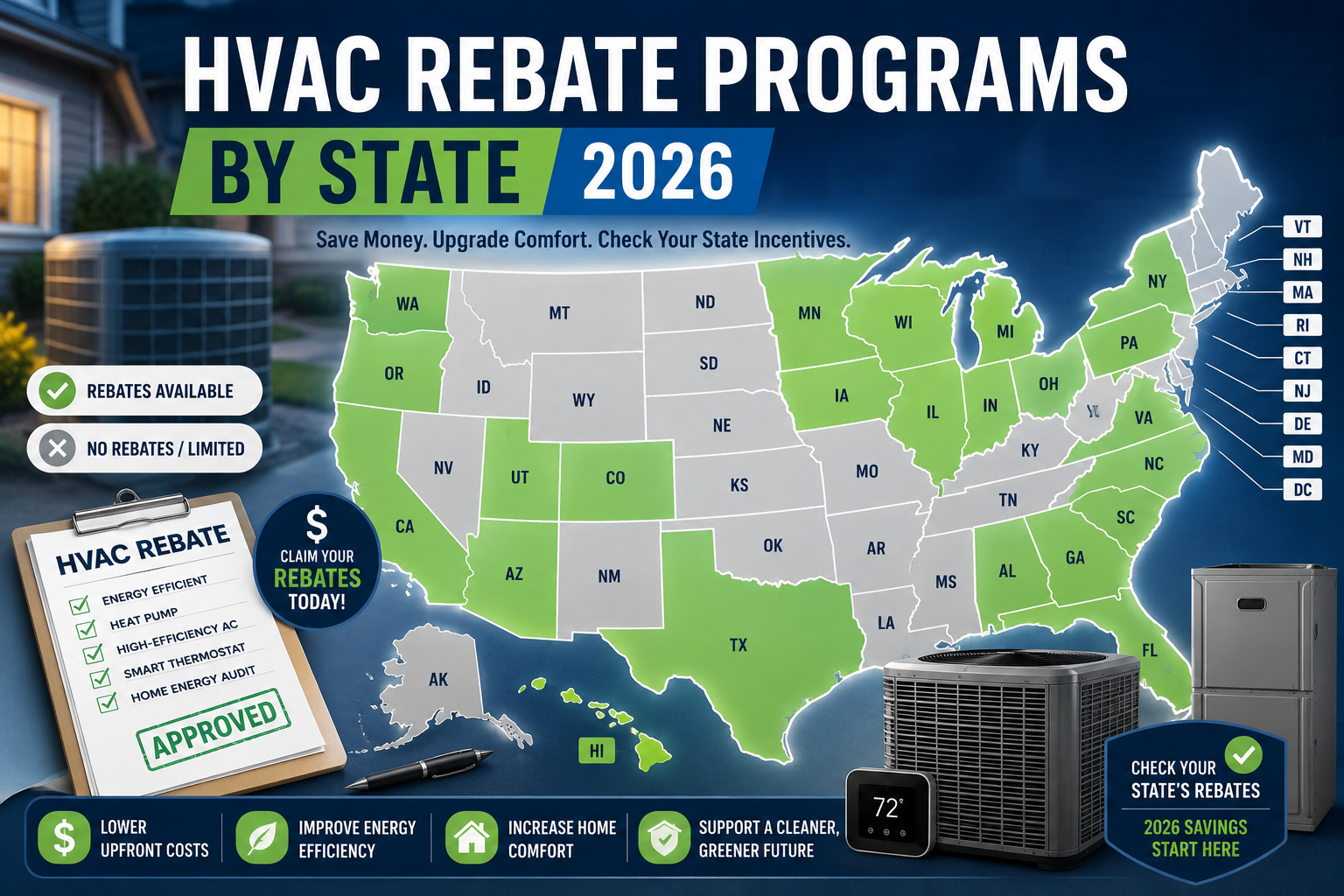
HVAC rebate programs by state vary so much in 2026 that the same ad copy that works in one market can actively mislead homeowners in another. Some states are expanding utility-funded incentives. Others have quietly let them shrink or disappear entirely. If your Google Ads campaigns reference “get your HVAC rebate” without checking which state — and sometimes which specific utility — actually has one live right now, you’re either overpromising or leaving real conversion advantage on the table.
Why HVAC Rebate Programs by State Look Nothing Alike in 2026
Unlike a single federal HVAC efficiency standard, rebate availability is set state by state, and often utility by utility within a state. Three examples make the range clear:
California runs some of the most active state-level HVAC incentive programs in the country. Between Title 24 building code requirements and TECH Clean California heat pump rebates, homeowners have real, current programs to reference — and campaigns that name them specifically outperform generic “energy efficient AC” messaging.
Pennsylvania sits in the middle of a genuine transition. Act 129, the state’s flagship utility efficiency law, moved through Phase IV rebates that closed to new purchases on May 31, 2026, with Phase V amounts not yet published by most utilities as of this writing. A separate $258.9 million federal program, Penn Energy Savers, also hasn’t launched yet. Homeowners in Pennsylvania aren’t short on interest — they’re short on clarity, and contractors who can explain the current status by utility territory have a real edge over ones who can’t.
Ohio shows the opposite direction entirely. House Bill 6, at the center of the largest public corruption scandal in Ohio history, eliminated the state’s mandatory utility efficiency standards in 2019. The rebate programs those standards used to fund largely disappeared, and regulators have mostly rejected utility attempts to bring them back since. Ohio HVAC campaigns that still lead with rebate messaging are marketing something that, in most of the state, doesn’t currently exist.
The Practical Problem for Multi-State or Franchise HVAC Companies
If you manage campaigns across more than one state — or run a franchise operation spanning several — a single rebate-focused ad template almost never works everywhere. What converts in Sacramento can mislead a homeowner in Cleveland. Building state-specific (and sometimes utility-specific) landing pages and ad copy isn’t optional at this point; it’s the difference between a click that converts and one that erodes trust the moment a homeowner calls to ask about a rebate that isn’t real.
How to Structure Campaigns Around This
1. Check current status before writing rebate copy, not after. A rebate that was accurate six months ago may not be today. The most reliable source for checking current, verified state-level programs is DSIRE, the Database of State Incentives for Renewables & Efficiency, maintained by the N.C. Clean Energy Technology Center.
2. Where rebates are active, name them specifically. “Save on energy costs” is generic. “TECH Clean California heat pump rebate” or “Act 129 utility rebate” is specific, current, and signals to the homeowner that you actually know their market — which matters more than most contractors assume.
3. Where rebates are gone or in flux, lead with financing and value instead. In states like Ohio, where broad rebates have largely disappeared, financing terms and transparent value messaging convert better than a rebate promise that can’t be delivered. Homeowners aren’t naive — an ad promising something that turns out to be unavailable costs you the call.
4. Reference your state licensing credential clearly, regardless of rebate status. Whether it’s CSLB in California, the PUC-regulated utility structure in Pennsylvania, or OCILB in Ohio, a verifiable state license is a trust signal that matters in every market, independent of what rebate programs are or aren’t currently funded.
Don’t Assume Last Year’s Program Details Are Still Correct
Utility rebate programs change status often enough that campaigns built once and left alone tend to drift out of accuracy within months, not years. A quarterly check against a source like DSIRE or the relevant state Public Utilities Commission page is a small amount of effort that protects both ad performance and homeowner trust.
FAQ
Are HVAC rebate programs by state the same nationwide?
No. Rebate availability is set at the state level, and frequently at the individual utility level within a state, which is why the same national ad template rarely performs consistently across multiple states.
What happened to federal HVAC tax credits?
The federal 25C and 25D residential energy tax credits ended December 31, 2025, and are no longer available — another reason state and utility-specific programs now matter more in campaign messaging than they did even a year ago.
How often should I check whether a state’s rebate program is still active?
At minimum quarterly, and immediately after any major news coverage of state energy policy, since programs can close to new applicants (as happened with Pennsylvania’s Act 129 Phase IV) with little advance notice.
What should I do in a state where rebates have disappeared?
Shift ad copy and landing pages toward financing options, transparent pricing, and long-term value messaging instead of a rebate that no longer exists — and make sure your state license credential is featured prominently as the trust signal in its place.
For a full breakdown of how EZEGrow builds rebate-aware campaigns in specific states, see our guides for California HVAC Google Ads, Pennsylvania HVAC Google Ads, and Ohio HVAC Google Ads.

Zeeshan Ali is the Founder of EZEGrow, a Google Ads management agency specializing in HVAC, plumbing, and water damage restoration companies across the United States. He focuses on lead generation, call tracking, campaign optimization, and helping home service businesses grow through data-driven Google Ads strategies.