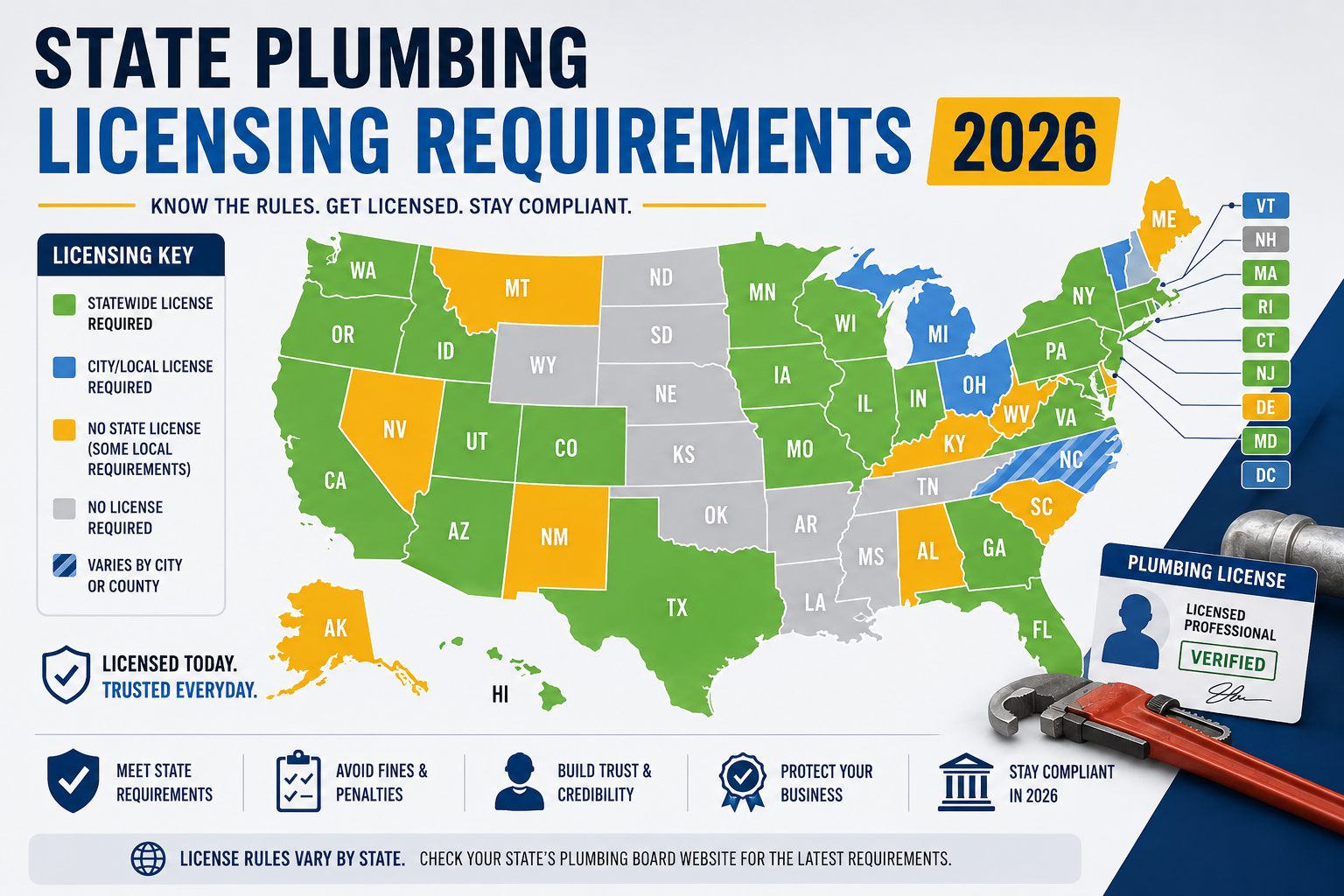
State plumbing licensing requirements vary so much across the US that a licensing claim accurate in one market can be flat-out wrong in another — and for plumbing companies running ads across state lines, or homeowners trying to verify a contractor, that inconsistency matters more than most marketing ever accounts for.
Why This Isn’t a Simple, Uniform System
Unlike some trades that follow a single national certification standard, plumbing licensing in the US is set almost entirely at the state or even municipal level, and the structure varies dramatically:
Illinois licenses plumbers statewide, but through the Illinois Department of Public Health (IDPH) — a health-department-based system tied to public water safety, distinct from the professional licensing boards most other states use.
Ohio layers three separate authorities on top of each other: the state’s OCILB issues a commercial plumbing license, nearly every county separately requires registration and bonding through its local health district, and cities like Cincinnati and Columbus add their own city-level journeyperson or residential licenses on top of that.
New York has no single statewide plumbing license at all. Licensing is handled independently by each municipality — New York City runs its own Master Plumber system through the Department of Buildings, while Buffalo, Nassau County, and dozens of other jurisdictions each run separate systems.
Pennsylvania also has no statewide license. Philadelphia licenses its own plumbers separately, and most of the rest of the state has no unified licensing requirement in the way states like Illinois or Texas do.
What This Means If You Market Across State Lines
A plumbing company operating in more than one state — or a franchise with locations across several — genuinely cannot use the same “licensed and insured” language everywhere and have it mean the same thing. A credential that’s accurate and verifiable in one market can be misleading, or simply inapplicable, in another.
This matters for two reasons. First, homeowners increasingly check licensing claims directly through state licensing-board search tools before hiring, and a vague or incorrect claim erodes trust the moment it’s checked. Second, in states with no unified license — like New York or Pennsylvania — the absence of a single credential to point to means other trust signals, like reviews, local registration, and specific county or city credentials, have to carry more of the weight in your marketing.
How to Handle This in Multi-State Campaigns
1. Never reuse licensing language across states without checking it first. “Fully licensed in [state]” needs to reference the actual licensing structure that applies there — a state board credential, a county registration, or a city-specific license, depending on where the ad is running.
2. In fragmented-licensing states, lean harder on local, verifiable specifics. In a state like Ohio, referencing the specific county registration and bond amount (some counties require bonds up to $10,000) is a stronger, more concrete trust signal than a generic licensing claim.
3. Use state-specific landing pages, not one licensing paragraph reused everywhere. Because the correct language differs by state — and sometimes by city within a state — a single national landing page referencing “licensed plumbers” without specifics underperforms pages built around the actual local credential.
4. Check licensing structure changes periodically. State licensing requirements do change. What was accurate two years ago in a given state may have shifted, particularly in states currently debating whether to introduce a unified license where none currently exists.
A Resource Worth Bookmarking
For companies operating across multiple states, the National Association of State Contractors Licensing Agencies maintains information on state-by-state contractor licensing structures and is a useful starting point before assuming any state’s requirements match another’s.
FAQ
Is plumbing licensing the same in every state?
No. Some states, like Illinois, license plumbers statewide through a single agency. Others, like New York and Pennsylvania, have no statewide license at all, with licensing handled entirely at the municipal level.
What should I do in a state with no unified plumbing license?
Reference whatever specific local credential actually applies — a city license, county registration, or bond — rather than a generic “licensed” claim that doesn’t correspond to any real, verifiable system in that state.
Why do some states use a health department for plumbing licensing instead of a contractor board?
States like Illinois tie plumbing licensing to public health because plumbing work directly affects drinking water safety, which is why the Illinois Department of Public Health, not a construction licensing board, issues the state’s plumbing licenses.
How often should multi-state plumbing companies review their licensing claims in ad copy?
At least annually, and immediately after expanding into any new state or market, since assuming one state’s licensing structure applies elsewhere is one of the most common — and most easily avoided — accuracy mistakes in multi-state plumbing marketing.
For a closer look at how licensing structure shapes campaign strategy in specific states, see our guides for Illinois Plumbing Google Ads, Ohio Plumbing Google Ads, New York Plumbing Google Ads, and Pennsylvania Plumbing Google Ads.

Zeeshan Ali is the Founder of EZEGrow, a Google Ads management agency specializing in HVAC, plumbing, and water damage restoration companies across the United States. He focuses on lead generation, call tracking, campaign optimization, and helping home service businesses grow through data-driven Google Ads strategies.